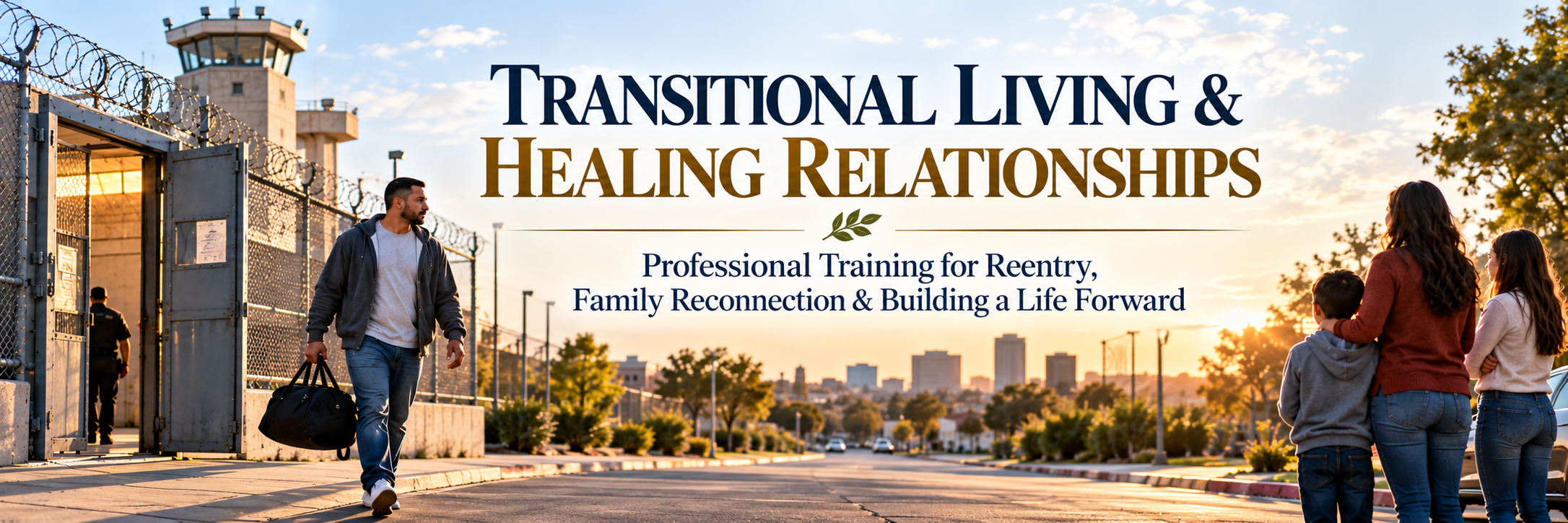

For Mediators & Restorative Justice Practitioners
Learn how restorative principles can be applied to reentry, accountability, family reunification, communication, and relationship repair.
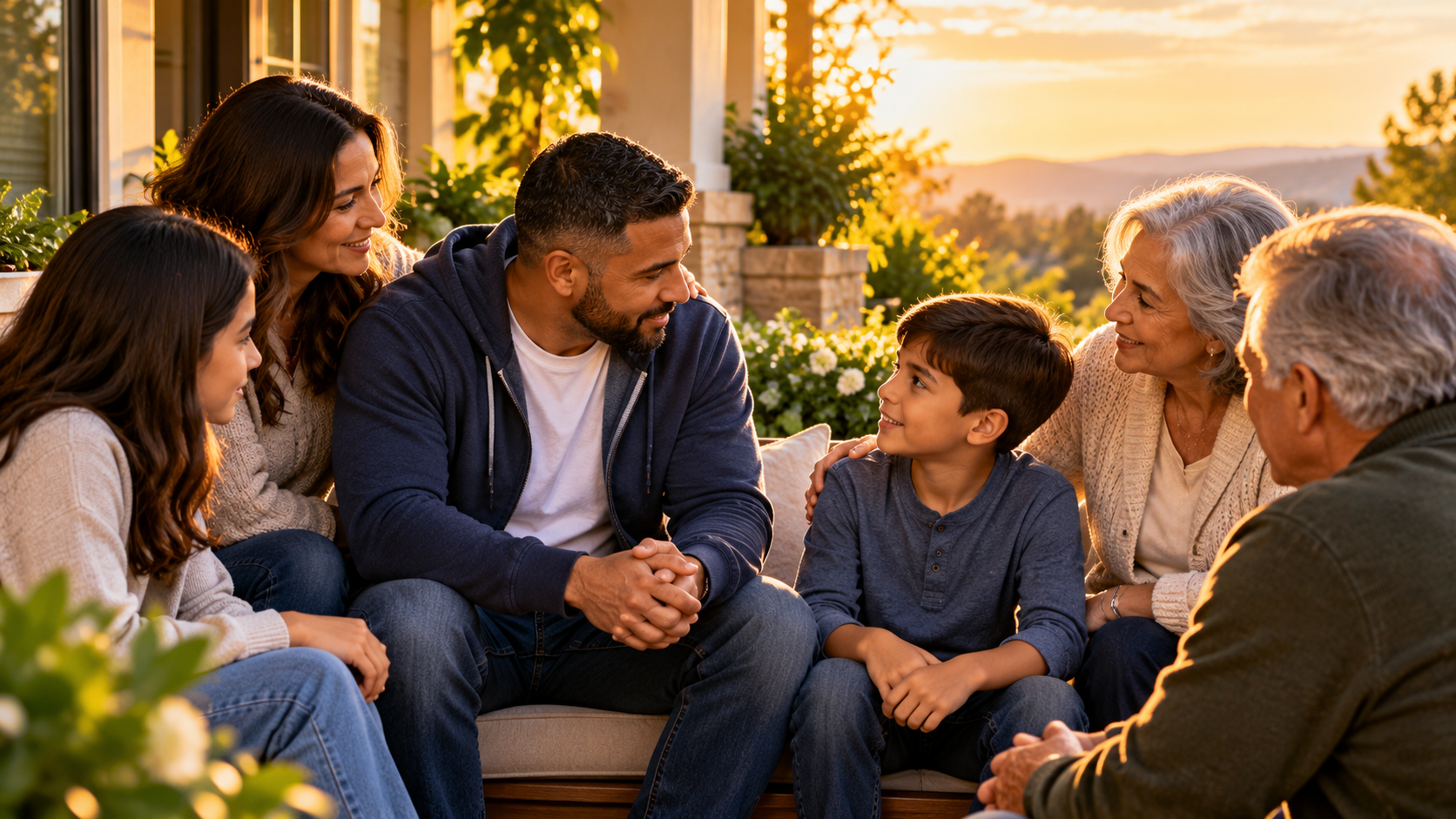
For Reentry & Transitional-Living Professionals
Develop practical approaches for supporting individuals and families as they navigate changed roles, expectations, boundaries, loss, trust, and reconnection.

For Educators, Counselors, Nonprofit Leaders & Advocates
Learn how restorative justice principles can support reentry, family reunification, and relationship repair. Develop a person-centered, family-centered approach for addressing the relational challenges that can arise when someone comes home.
About This Course
Release from incarceration happens in a day. But reunification takes time. Years of separation change relationships. Children grow up. Partners become more independent. Trust gets damaged. Communication becomes difficult. And everyone—the returning person, the spouse, the children, the caregivers—carries their own story. This course teaches Transitional Living & Healing Relationships practices that create space for all those stories to coexist. You'll learn how to have the hard conversations, take responsibility, rebuild trust, understand what's changed, repair what can be repaired, and create a new path forward together. This isn't about pretending everything goes back to normal. It's about learning how to come home—really come home—to the people you love. Ready to transform a relationships after incarceration? Enroll Below

Learn How to Support Reentry, Reconnection & Relationship Repair
Restorative Justice for Transitional Living & Healing Relationships is a professional training program designed for mediators, restorative justice practitioners, reentry and transitional-living professionals, educators, counselors, nonprofit leaders, advocates, and others who support individuals and families affected by incarceration. Learn how restorative justice principles can help address the relational challenges of reentry—including changed family roles, communication, loss, accountability, trust, boundaries, parent-child reconnection, family reunification, and relationship repair. Through practical tools, realistic scenarios, restorative questions, and a person-centered, family-centered approach, this training prepares professionals to support individuals and families as they navigate the transition home and determine what a healthy path forward can look like.
Press Release: Reentry: Rebuilding Family Relationships After Incarceration
Reentry: Rebuilding Family Relationships After Incarceration New professional training gives reentry, restorative justice and family-service professionals practical tools for navigating accountability, trust, family reunification and relationship repair. TEMECULA, Calif. — Returning home after incarceration can mark the end of one journey and the beginning of another. While housing, employment, transportation and community resources are critical components of successful reentry, returning to family life can present challenges that are less visible and often far more complicated. Children have grown. Partners have changed. Parents and grandparents may have assumed caregiving roles. Household routines have been established without the returning family member. Years of separation may have affected communication, trust, attachment and expectations on both sides. Recognizing the need for professionals to have practical tools for addressing these relational challenges, Professional Studies | Mediation Training Center, based in Temecula, California, has launched Transitional Living & Healing Relationships, a new seven-lesson, self-paced online professional training program. Created for professionals and organizations already serving individuals and families affected by incarceration, the training provides a restorative framework for addressing the human and relational side of reentry. “Coming home is an event. Reconnection is a process,” said Darlene Pinkernell-Tarnoski, mediator, national trainer, author and course creator. “A person can be released on a particular day, but rebuilding relationships doesn't happen on a release schedule. The returning person has a story. The spouse has a story. The child has a story. The caregiver has a story. Professionals need practical ways to help people navigate those different experiences.” Beyond Curriculum: Tools Professionals Can Put to Work The training goes beyond presenting restorative justice concepts. Participants are provided with professional tools, structured forms, realistic case scenarios, restorative questions, guided assessments, planning exercises and family-conversation resources that can be incorporated into professional practice and reentry-support settings. The program addresses the transition from incarceration to everyday life; changed family roles; loss and separation; communication and conflict; accountability without shame; rebuilding trust; boundaries and expectations; parent-child reconnection; parenting after incarceration; family reunification; restorative family conversations; and developing sustainable plans for moving forward. Practical resources include tools for assessing family-reunification readiness, identifying expectations about returning home, preparing for difficult conversations, developing healthy boundaries, planning accountability and repair, rebuilding trust, supporting parent-child reconnection, preparing restorative family conversations, developing family agreements, identifying support networks and creating 30-, 60- and 90-day reentry and relationship plans. Realistic scenarios and case studies place those tools into context, helping professionals consider how restorative principles may be applied when family members have different memories, expectations, needs and boundaries. Reconnection Does Not Mean Forced Reconciliation A central principle of the training is that successful reentry does not require every relationship to return to what it was before incarceration. Participation, safety, choice and appropriate boundaries remain essential. Family reunification may be gradual. A parent-child relationship may develop differently than expected. Coparenting may be possible even when romantic reconciliation is not. In some circumstances, maintaining boundaries or choosing not to reconcile may be the healthiest outcome. The role of the professional is not to determine what a family relationship should become, but to provide a structured process in which accountability, impact, needs, boundaries and possible paths forward can be explored. Designed for the Professionals Already Doing the Work Restorative Justice for Transitional Living & Healing Relationships is designed for mediators, restorative justice practitioners, reentry and transitional-living professionals, probation and parole professionals, case managers, counselors, educators, nonprofit leaders, advocates, family-service professionals and organizations working with individuals and families affected by incarceration. The seven-lesson training is completed online and at the participant's own pace. Tuition is $249. “Professionals working in reentry are already doing incredibly important work,” Pinkernell-Tarnoski said. “My goal was to give them more than curriculum. I wanted them to leave the training with practical resources they can actually use when a family is sitting in front of them trying to figure out what comes next.” Because release can happen on a particular day. Rebuilding a family relationship takes time.
What You'll Learn
-
-
(Included in full purchase)
TABLE OF CONTENTS Restorative Justice for Transitional Living _ Healing Relationships
-
(Included in full purchase)
Welcome to the Training
-
(Included in full purchase)
Why Relationships Matter in Reentry
-
(Included in full purchase)
Understanding the Transition Home
-
(Included in full purchase)
The Role of Restorative Justice
-
(Included in full purchase)
A Person-Centered and Family-Centered Approach
-
(Included in full purchase)
Safety, Choice, and the Limits of Reunification
-
(Included in full purchase)
How to Use This Course
-
(Included in full purchase)
Module 1 — The Transition From Incarceration to Everyday Life
-
(Included in full purchase)
Module 2 — Families in Transition
-
(Included in full purchase)
Time to submit the Reflection & Open-Ended Assessment
-
(Included in full purchase)
-
-
(Included in full purchase)
LOVE, LOSS, SEPARATION & RECONNECTION
-
(Included in full purchase)
Time to submit the Reflection & Open-Ended Assessment
-
(Included in full purchase)
-
-
(Included in full purchase)
COMMUNICATION, CONFLICT & COMPROMISE
-
(Included in full purchase)
Time to submit the Reflection & Open-Ended Assessment
-
(Included in full purchase)
-
-
(Included in full purchase)
ACCOUNTABILITY, TRUST & RELATIONSHIP REPAIR
-
(Included in full purchase)
Please submit the Reflection & Open-Ended Assessment to [email protected]
-
(Included in full purchase)
-
-
(Included in full purchase)
CHILDREN, PARENTING & FAMILY REUNIFICATION Download
-
(Included in full purchase)
Please submit the Reflection & Open-Ended Assessment to [email protected]
-
(Included in full purchase)
-
-
(Included in full purchase)
RESTORATIVE CONVERSATIONS FOR FAMILIES
-
(Included in full purchase)
Time to submit the Reflection & Open-Ended Assessment
-
(Included in full purchase)
-
-
(Included in full purchase)
BUILDING A LIFE FORWARD
-
(Included in full purchase)
Please submit the final Reflection & Open-Ended Assessment to [email protected]
-
(Included in full purchase)
-
-
(Included in full purchase)
PROFESSIONAL PRACTICE TOOLKIT
-
(Included in full purchase)
Build the Skills to Support Reentry, Reconnection & Relationship Repair
Reentry involves more than housing, employment, and community resources. For many individuals and families, some of the most difficult work begins within the relationships affected by years of separation. This professional training explores how Transitional Living & Healing Relationships principles can be used to support accountability, communication, family reunification, healthy boundaries, trust-building, and relationship repair during the transition home. Through practical tools, scenarios, restorative questions, and real-world applications, participants learn how to support individuals and families without assuming that reconciliation is always possible—or appropriate.
$249.00